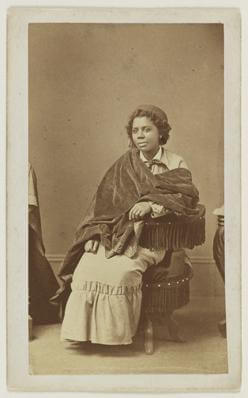
MARY EDMONIA LEWIS
- Program
- Subject
- Location
- Lat/Long
- Grant Recipient
-
NYS Historic
-
Arts & Culture, People
- 589 3rd Avenue, Rensselaer, NY 12144, USA
- 42.64426478355, -73.703550544671
-
Town of East Greenbush
MARY EDMONIA LEWIS
Inscription
MARY EDMONIA LEWIS1844-1907. BORN IN THE TOWN OF
GREENBUSH. WORLD RENOWNED
SCULPTOR. CARVED CRITICALLY
ACCLAIMED PIECES INCLUDING
DEATH OF CLEOPATRA IN 1876.
WILLIAM G. POMEROY FOUNDATION 2026
Mary Edmonia Lewis was born in 1844 in the Town of Greenbush—now East Greenbush, North Greenbush, and the City of Rensselaer—and rose to become a world‑renowned sculptor. Her heritage shaped her early life: her father was African American, her mother was a Chippewa woman, and Lewis, known in childhood as “Wildfire,” was raised by her aunts on a Chippewa reservation after losing both parents by age eight. The tribe’s matriarchal traditions, where women held authority and property, deeply influenced her worldview.
Supported by her older brother Samuel, she attended schools in Albany and McGrawville before enrolling at Oberlin College in 1859. There she discovered her artistic talent but also faced racial and cultural hostility. In 1862 she was falsely accused of poisoning two classmates; before her hearing she was abducted, beaten, and left unconscious in the snow. Though eventually exonerated for lack of evidence, the harassment that followed forced her to leave Oberlin without completing her studies.
Lewis moved to Boston, where sculptor Edward A. Brackett mentored her. She supported herself by selling clay medallions and soon completed her first major work—a bust of Colonel Robert Gould Shaw in 1864. In 1865 she relocated to Rome, where she trained in the Neoclassical style, worked in marble, and found a more accepting artistic community. Her major works include Hiawatha (1868), Henry Wadsworth Longfellow (1871), Moses (1875), and numerous others. Her most famous sculpture, The Death of Cleopatra (1876), was exhibited at the Centennial Exposition in Philadelphia, later lost, and eventually rediscovered in a shopping‑mall storage room before being restored and placed in the Smithsonian in 1994.
Lewis spent her final years in London, where she died in 1907 from Bright’s disease. She was buried at St. Mary’s Catholic Cemetery, and her grave has since been restored with a new memorial—an acknowledgment of the lasting legacy of a groundbreaking artist who overcame extraordinary adversity to shape American art history.