Hungry for History® Marker Grant Program
The Hungry for History® grant program celebrates America’s food history by telling the stories of local and regional food specialties across the United States. This program is designed to commemorate significant food dishes created over 50 years ago and the role they played in defining American culture and forging community identity. Hungry for History is intended to help communities nationwide put the spotlight on their renowned locally and regionally created food dishes with historical roadside markers.
Before applying, please review the information on this page, as well as the Marker Criteria, Primary Sources, and FAQ tabs above. Reviewing our guidelines and requirements will help ensure your submission for a Pomeroy Marker grant is as strong as possible. Once you’ve reviewed the details, click the Apply button at the bottom of the page to access our online portal.
Ready to apply? Get started here: Apply for Grant
Eligibility to Apply for Grant
This program is open to local, state and federal government entities, nonprofit academic institutions, and 501(c)(3) organizations. Applicants may apply for up to five (5) markers per grant round. Interested individuals are encouraged to contact an eligible local organization, such as a municipal historian or historical society.
Subject Criteria
Foods/subjects we can accept include:
- Prepared, ready-to-eat dishes, such as an entrée or dessert, containing a minimum of 2 ingredients
- Dishes composed of a single ingredient that are only found within a specific location or region (e.g. Blue Point oysters from Great South Bay, Dungeness crabs from Pacific coast)
- Non-alcoholic drinks with more than one ingredient (e.g. egg creams)
- Food-related events or festivals that celebrate an individual dish that is historically significant to the greater community (events held solely as fundraisers do not qualify) and must still be held at time of application
- Please note, you cannot apply for separate markers celebrating a food dish and its related festival.
Additional subject criteria:
- Dish or event must be created at least 50 years prior to the year of application
- Dish or event must be historically significant to the greater community or beyond, demonstrating a local tradition or aspect of cultural heritage
- Dish (or specific variation) must have origins in the local or regional community
- Dish is still available/eaten today or in some form
- No brand names allowed (e.g. Hershey’s, Kraft, etc.)
What does not qualify?
- Alcoholic beverages
- Foods/dishes only available commercially or from one specific restaurant. Foods must be a community-rooted tradition, going beyond one brand or restaurant.
Marker Design and Text
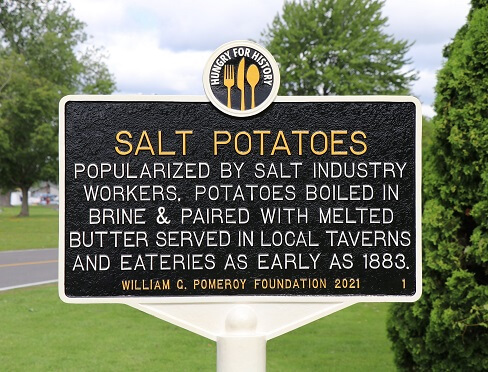
Hungry for History® markers are black with yellow raised lettering and border. The top of each marker has the Hungry for History® logo, which states the program name and depicts cutlery. Markers are 32” x 18” cast aluminum with a 7’ aluminum pole.
The title line allows 15 characters, and the five body lines can each have 27 characters, including spaces and punctuation. There is a required credit line at the bottom of the marker which is always included.
Please note, the marker text must include a brief description of the dish, which covers an overview of its ingredients and cooking process, since the public may be unfamiliar with the dish. For example, for Salt Potatoes the marker reads “potatoes boiled in brine & paired with melted butter” as a description.
Please see our Marker Criteria page for more information, as well as a helpful guide.
Historical Accuracy

Primary source documentation is required to verify historical accuracy. The applying agency is responsible for providing images/scans of sources and specific statements used to verify historical facts. Lists of links alone will not be accepted. If the William G. Pomeroy Foundation cannot substantiate the historical accuracy based on the supporting documentation provided, the application will not be successful.
The inscription on all Hungry for History markers must be proven historically accurate with primary source documentation (e.g. menus, business records, newspaper articles published at the time of the food’s origination). In addition, marker applications must include a list of ingredients used in the dish, with a source to support the recipe (e.g. the ingredients for Syracuse salt potatoes include small new potatoes with skin still on, salt, and butter).
Please see our Primary Sources page for more information, as well as a helpful guide.
Verification Standards and AI
Primary source verification is at the core of what we do at the William G. Pomeroy Foundation. Every historical marker we fund must be supported by primary sources created at the time of the events, or by first-hand witnesses. Our commitment to historical accuracy is our gold standard, ensuring that marker inscriptions are factual, verified, and will endure the test of time. Therefore, we do not accept information generated by artificial intelligence (AI). In addition to mimicking authentic sources that appear legitimate but do not exist (sometimes called “hallucinating” or “fabricating”), AI works by summarizing information from secondary sources on the internet or from unverified databases, which we do not accept. AI cannot generate an accurate report based solely on primary sources at this time. For these reasons, we do not accept AI-generated results as valid sources. June 2026
Marker Placement
Please carefully consider the location where the marker is to be installed.
- Markers should not be placed on high-traffic roadways or roadways where vehicles are traveling at a high rate of speed if there is no place for a vehicle to safely pull over out of traffic.
- Markers should not be placed where the visitor must intrude on private property to read it or view a site related to the marker inscription.
- Before installing your marker, please be sure you are following all of your state guidelines around digging and excavation.
For more information about marker location requirements, see our Marker Criteria page.
Application Procedure
We only offer an online application. The grant application has two parts: The Letter of Intent (LOI) and the application. The LOI is a required first step and allows Foundation staff to determine if additional primary sources are required and if the proposed marker text fits our criteria before the applicant completes a full grant application. Typically, LOIs are responded to within one week. You cannot access the full application until the LOI is approved.
LOIs must include the following:
- A list of primary source citations
- A proposed inscription for the marker
Applications must include the following:
- A proposed installation location with specific details (including GPS coordinates and an optional photo upload)
- A brief description and explanation of the historical significance of what is being commemorated
- A proposed inscription for marker
- A letter from the landowner granting permission for the marker to be installed on their property
- Primary source documents verifying the proposed inscription
Evaluation can take up to three months after submission. You may be contacted for additional information, so be sure to use an email that is checked regularly.
Approved marker grants are fully funded and include the marker, pole, and shipping costs. If approved, the Foundation will send a Letter of Agreement to be signed. When the letter is signed, a check is mailed for the total amount made payable to the applying agency. The agency is responsible for cashing the check, then issuing the payment to the foundry and sending in the order form provided. Instructions for ordering the marker will accompany the grant check. The grant recipient is responsible for installation of the marker, and we provide an installation guide as well.
For more detailed instructions, see our How to Apply guide: How to Apply
Application Deadlines in 2026
Important Dates
ROUND 1
- 3/16/26 – Application becomes available online
- 4/17/26 – Deadline to submit Letter of Intent (LOI) to verify primary sources.
- 5/18/26 – Application deadline
ROUND 2
- 9/4/26 – Application becomes available online
- 10/2/26 – Deadline to submit Letter of Intent (LOI) to verify primary sources.
- 11/9/26 – Application deadline
Evaluation can take up to three months after the grant round closes. We will email you with a status update.
Please note, student-led applications for Hungry for History markers will be accepted on a rolling basis through our Pomeroy Education Program. Educators may complete the LOI with their students at any time. Go to our education program page for more information.
Questions?
Contact Christy at info@wgpfoundation.org or 315-913-4060, Monday – Friday between 8:00 am and 4:30 pm (EST).