VOTES FOR WOMEN
- Program
- Subject
- Location
- Lat/Long
- Grant Recipient
-
National Votes for Women Trail
-
People
- 435 W Washington St, Greenville, SC 29601, USA
- 34.851557, -82.405166
-
National Collaborative for Women's History Sites
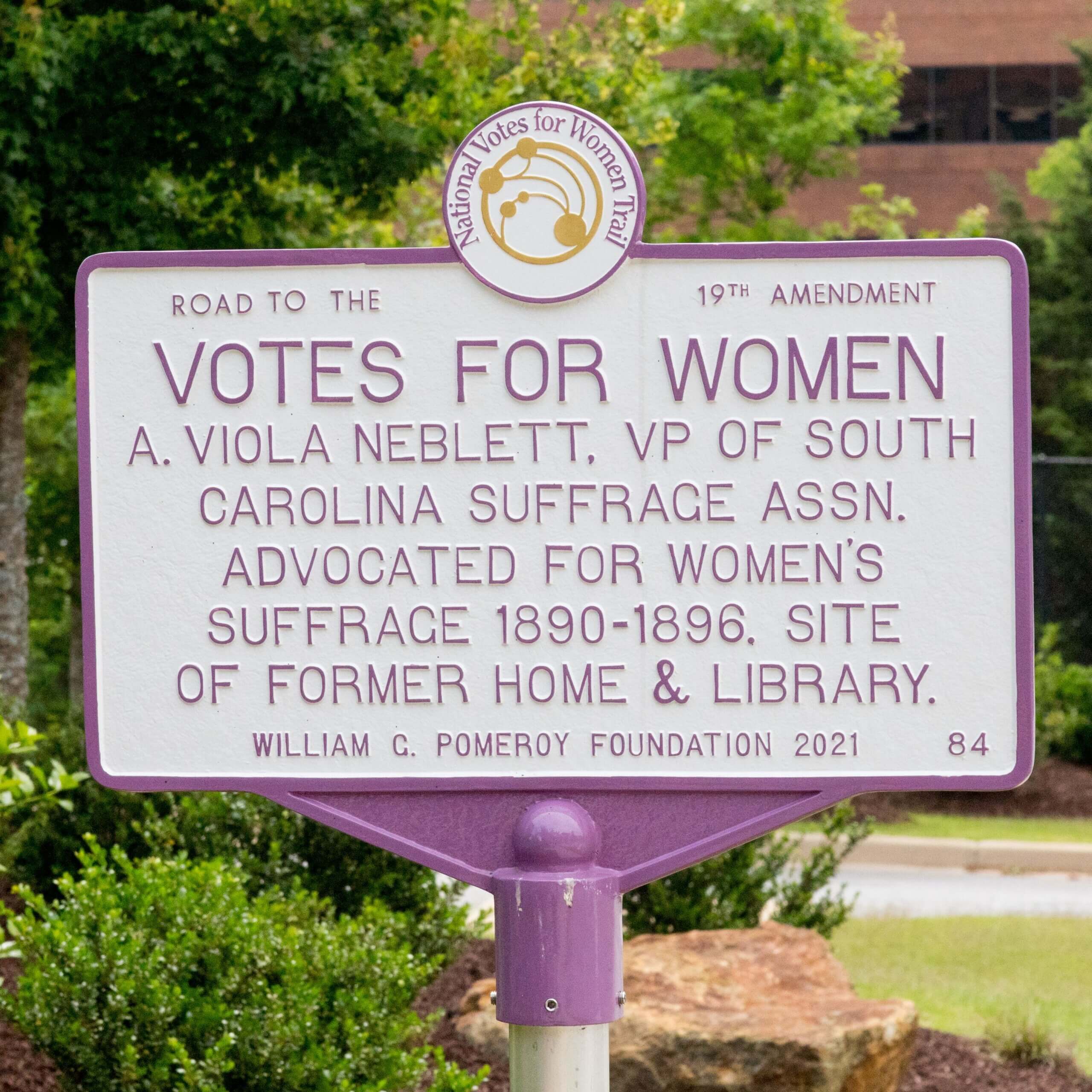
VOTES FOR WOMEN
Inscription
VOTES FOR WOMENA. VIOLA NEBLETT, VP OF SOUTH
CAROLINA SUFFRAGE ASSN.
ADVOCATED FOR WOMEN'S
SUFFRAGE 1890-1896. SITE
OF FORMER HOME & LIBRARY.
WILLIAM G. POMEROY FOUNDATION 2021
Woman as an intelligent, responsible being should have a voice in law-making. Now she has indirect influence without responsibility, which is demoralizing.
– A. Viola Neblett in “The New Woman of the New South” by Josephine K. Henry, The Arena, vol. XI, 1895.
Viola Neblett (1842-1897) was a prominent temperance and women’s rights advocate in South Carolina. In 1890, Neblett and others held a women’s rights conference in Greenville, where they pledged to work for women’s right to vote. They established the South Carolina Equal Rights Assocation and traveled through the state organizing local chapters. Neblett served as vice-president of the South Carolina Equal Rights Association and campaigned throughout the state, speaking on women’s suffrage. In 1895, South Carolina held a constitutional convention to draft a new state constitution. Neblett along with other suffrage advocates addressed the convention in support of women’s suffrage being included in new constitution. Despite these efforts, women’s suffrage was ultimately rejected by the convention and was not included in the 1895 constitution.
Neblett died in 1897 and her Greenville home was given to be used as a library. No longer standing, her home was located at the corner of West McBee Avenue and West Broad Street in Greenville. The Neblett Free Library was in use until 1921.
In 1919, the United States Congress passed the Nineteenth Amendment which states, “The right of citizens of the United States to vote shall not be denied or abridged by the United States or by any State on account of sex.” While the state of South Carolina rejected the amendment, by August 1920, 36 other states had ratified the amendment, securing women’s right to vote across the United States, including in South Carolina.