BURGOO FESTIVAL
- Program
- Subject
- Location
- Lat/Long
- Grant Recipient
-
Hometown Heritage®
-
Event, Site
- 203 S Clark St, North Utica, IL 61373, USA
- 41.339971, -89.010135
-
LaSalle County Historical Society
BURGOO FESTIVAL
Inscription
BURGOO FESTIVALHELD BY LASALLE COUNTY
HISTORICAL SOCIETY SINCE 1969.
A SEASONED MEAT & VEGETABLE
STEW PIONEERS COOKED IN IRON
KETTLES OVER AN OPEN FIRE.
WILLIAM G. POMEROY FOUNDATION 2026
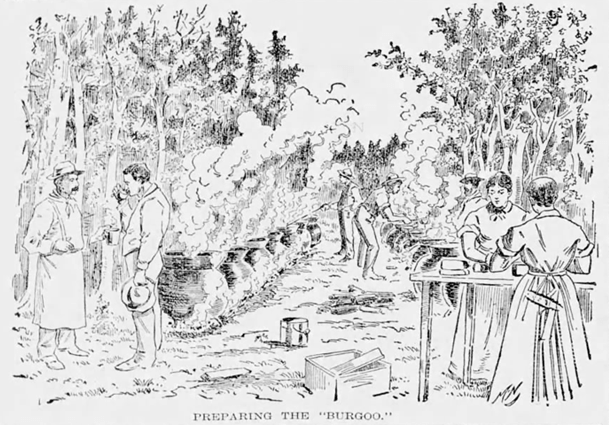
Burgoo is a stew that originated in the Kentucky region. The word “burgoo” is thought to have originally been used to describe sea-farers porridges in the mid-1700s. By the late 1700s and early 1800s as westward exploration continued in the Americas, the term came to be used to describe the stew made by pioneers in Kentucky. Burgoo stew during this time consisted of wild game- often venison, squirrel, opossum, racoon, and game birds, along with vegetables like lima beans, corn, okra, tomatoes, potatoes, and cabbage. Burgoo requires meat, vegetables, and spices to be cooked in a pot over an open fire for long periods of time, resulting in a very thick stew. Due to its long cooking time, it is often a community effort, requiring stirring to be done in shifts. Burgoo is cooked anywhere from eight to eighteen hours.
Burgoo was brought from Kentucky into Illinois by early pioneers in the 1820s, where it took root in many communities across the state. In one account of a Burgoo held in Chicago in 1895, the author described the entire town’s men gathering game for days ahead of time- including rabbits, pigeons, blackbirds, squirrels, fish, and anything they could catch. By this time other meats were being used as well, and the author wrote that the wild game was just for flavor- hundreds of pounds of beef and mutton were the main source of protein. Carrots, corn, potatoes, onions, and cabbage were added. They described a team effort of digging trenches and building fires for the pots of stew to cook over, and then teams starting to cook at 4am, and running the pots for 8 hours before serving. The author also described the custom as a “neighborhood affair”, “not a tool of the politician”, and “not a moneymaking affair” (The Chicago Chronicle, August 26, 1895).
By the 1960s, holding Burgoos was an annual tradition for many communities across the state of Illinois, such as Franklin and Winchester. In Utica, the nearest annual Burgoo was held in the town of Arentzville, about 8-9 miles away. In 1969, the LaSalle Historical Society had just established a museum in Utica and were in need of a fundraising idea. A member, Connie Fetzer, suggested they hold a Burgoo, and this was well received because of its historical roots. Not only did it have precedent as a fundraiser in other nearby towns, but it fit the Historical Societies mission of connecting people to their historical roots.
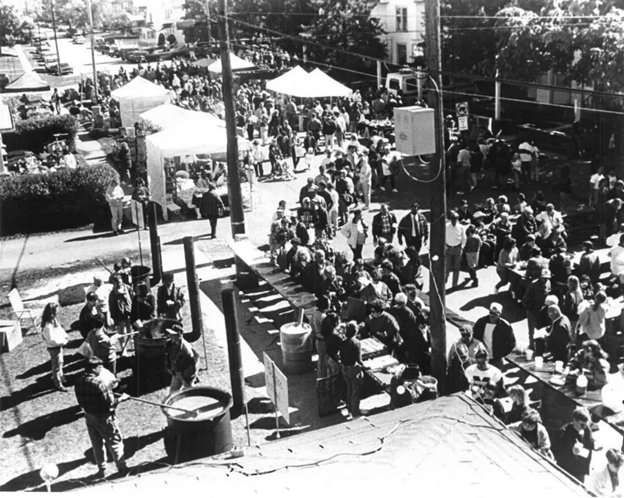
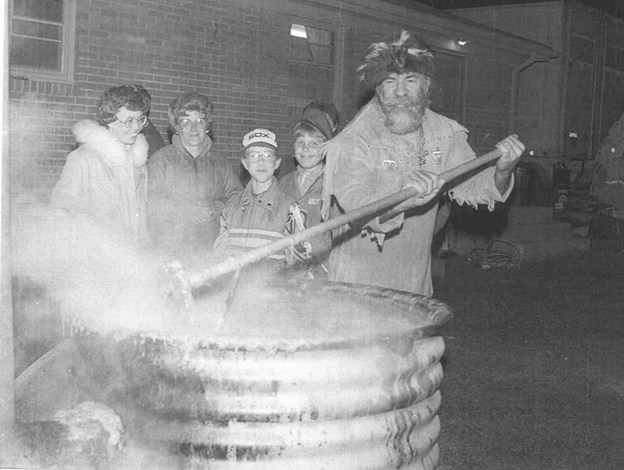
The festival took off and has been held yearly ever since. Community members work in teams stirring the stew as it cooks overnight, some even sleeping on the floor nearby. They use a more modern combination of beef, cabbage, carrots, potatoes, onions, and peppers (state law prevents wild game use). Only their “Burgoomeister” knows the exact recipe to use, a role that has been passed on through the generations. The stew is still cooked outdoors over an open fire in large kettles, as the pioneers would have done. The festival has grown far beyond just a museum fundraiser, now featuring a parade, live music, hundreds of vendors, and drawing thousands of people. Their estimated annual attendance is between 85-100K (as of 2025).