BUSHNELL’S BASIN
- Program
- Subject
- Location
- Lat/Long
- Grant Recipient
-
Historic Transportation Canals
-
Transportation
- 624 Pittsford Victor Rd, Pittsford, NY 14534, USA
- 43.062452, -77.478472
-
Town of Perinton
BUSHNELL’S BASIN
Inscription
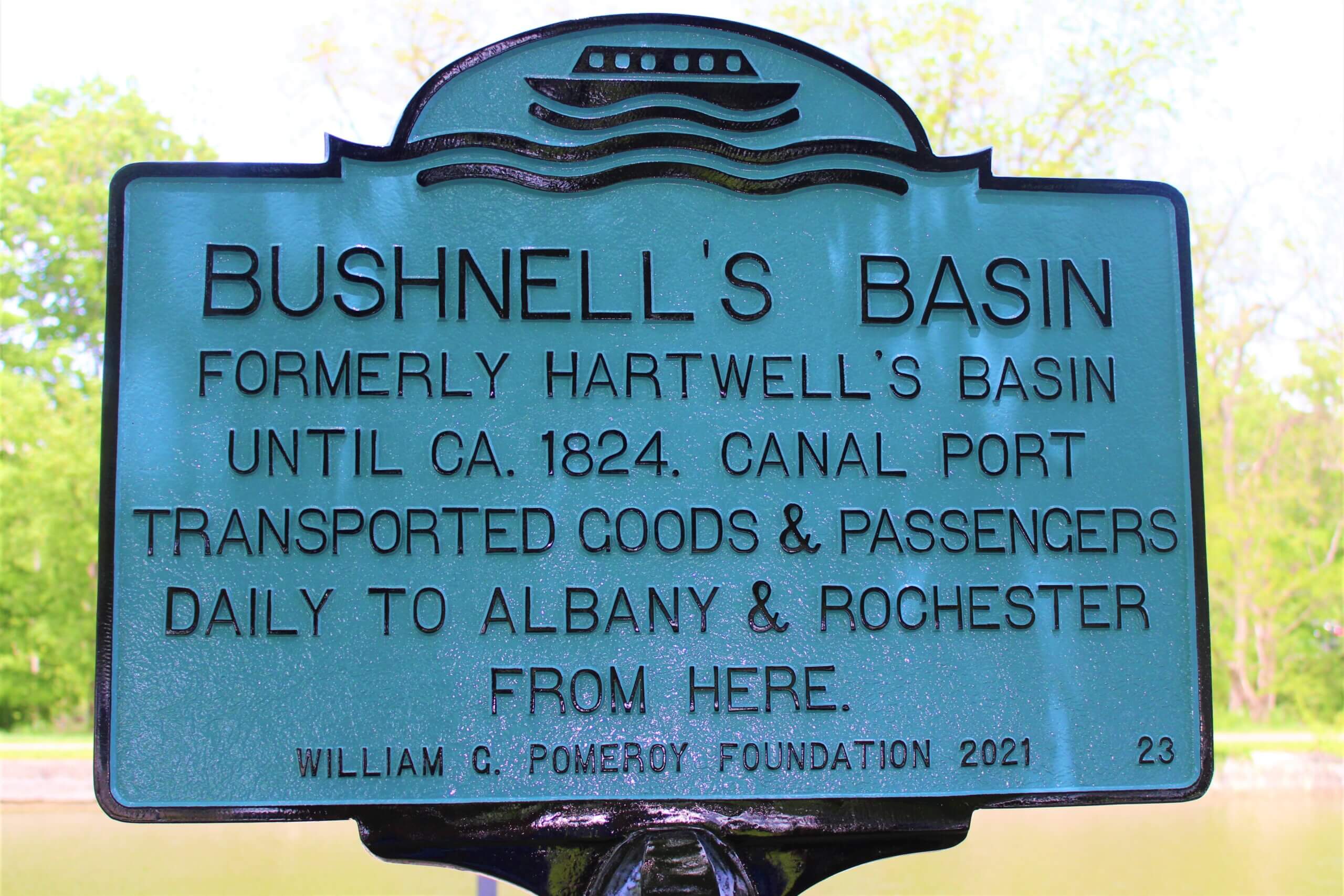
BUSHNELL'S BASINFORMERLY HARTWELL’S BASIN
UNTIL CA. 1824. CANAL PORT
TRANSPORTED GOODS & PASSENGERS
DAILY TO ALBANY & ROCHESTER
FROM HERE.
WILLIAM G. POMEROY FOUNDATION 2021
Requiring nearly a decade to complete, the Erie Canal remains an impressive feat of engineering. Spanning 363 miles, this artificial waterway featured locks, bridges, and aqueducts along its path through the diverse geography of New York State. It connected the Great Lakes region to the commercial hub of New York City; in many instances, the canal utilized natural waterways and lakes as a means of reaching interior communities. Several branch canals were constructed in subsequent decades until railroads superseded the canal system.
The Erie Canal opened through most of Monroe County in 1822, including what is now Bushell’s Basin in the Town of Perinton. An early canal passenger described his travels here in the July 16, 1822 issue of the Connecticut Courant:
We lodged that night at Palmyra, and the next morning we arrived at Heartwell’s Basin in Pittsforfd, (8 miles from Rochester,) where the present navigation of the canal terminates. I have thus travelled 174 miles by boat – 159 on the canal, 15 on the river Clyde.
Formerly Hartwell’s (or Heartwell’s) Basin, Bushnell’s Basin was recognized a principal canal port in the Erie & Junction Canal Directory by 1828. Its location along the canal bolstered economic development and opened the area to larger markets. The local merchant, Bushnell, Wilmarth & Co., offered a variety of groceries and dry goods, freight storage and forwarding, as well as dry docks. Additionally, the Merchant’s Daily Line conveyed freight and passengers each day from Bushnell’s Basin to Brockport and Albany.
As of 2021, the marker stood along the Town of Perinton’s Canal Walk, where the Erie Canal is now a recreational resource.