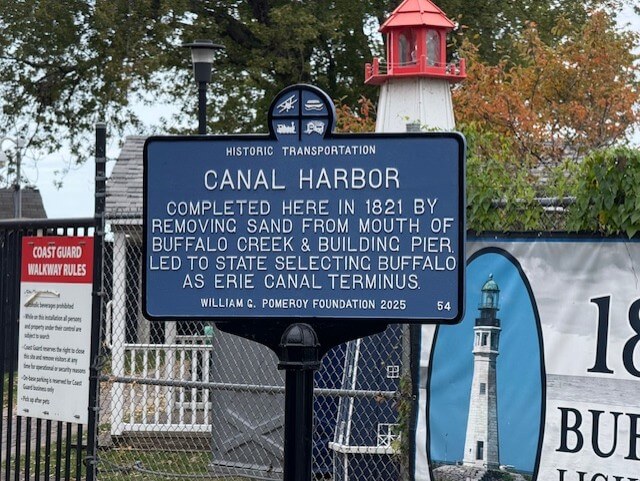
CANAL HARBOR
- Program
- Subject
- Location
- Lat/Long
- Grant Recipient
-
Historic Transportation
-
Site, Transportation
- 1 Fuhrmann Boulevard, Buffalo, NY 14203, USA
- 42.876678, -78.884199
-
City of Buffalo
CANAL HARBOR
Inscription
CANAL HARBORCOMPLETED HERE IN 1821 BY
REMOVING SAND FROM MOUTH OF
BUFFALO CREEK & BUILDING PIER.
LED TO STATE SELECTING BUFFALO
AS ERIE CANAL TERMINUS.
WILLIAM G. POMEROY FOUNDATION 2025
In 1821, the construction of a harbor was completed in Buffalo, New York. Sand had been removed from the mouth of Buffalo Creek, a tributary of Buffalo River, and a pier was built that extended out into Lake Erie. With the completion of its harbor, Buffalo secured its spot as the terminus of the Erie Canal, fueling its growth as a major transportation center.
As early as 1816, Buffalo citizens acknowledged the need for a harbor, with a committee forming to encourage the development of a “safe and convenient harbor” through the removal of the sand bar at the mouth of Buffalo Creek (Buffalo Gazette, December 3, 1816, 3). The mouth of the creek was essentially blocked by a sand bar, stopping vessels from being able to enter. The harbor effort was further spurred on by the construction of the Erie Canal, which began in 1817. Prior to the opening of the canal, there was debate as to where its ending point should be located, with Buffalo on Lake Erie and the former village of Black Rock on Niagara River both vying for the position. At one point an independent village, Black Rock would later be annexed by the growing city of Buffalo in 1853.
With Buffalo competing to be the terminus of the canal, the construction of the harbor became essential. With the completion of Buffalo’s harbor in 1821, the Canal Commissioners officially determined that Buffalo would be the termination point of the canal (Long-Island Star, June 27, 1822, 2). Following its completion, the August 13, 1822 Ontario Repository reported on the success and impact of the new harbor:
Yesterday, fourteen of the largest vessels that sail the Lakes, were safely moored in Buffalo Harbor. It was truly a gratifying spectacle, and is indicative of the rapidly increasing commerce of these waters. An estimate of the capacity of the Creek has been made by several gentlemen of excellent judgement, and they unite in the opinion that several hundred vessels, with equal safety and convenience, could remain in this Harbor.
With the opening of the Erie Canal in 1825, the canal harbor allowed Buffalo to be accessible to both vessels on the Great Lakes and canal boats that traversed the state, aiding in the transport of people and goods throughout the region. As a result, Buffalo grew into a major transportation hub and experienced a population boom, with the population of Buffalo growing approximately 300% between 1820 and 1830 (https://www.wgpfoundation.org/historic-markers/the-erie-canal/).
As of 2025, the former canal harbor area is at the heart of downtown Buffalo’s waterfront revitalization efforts and is host to hundreds of public events throughout the year, including concerts and festivals.