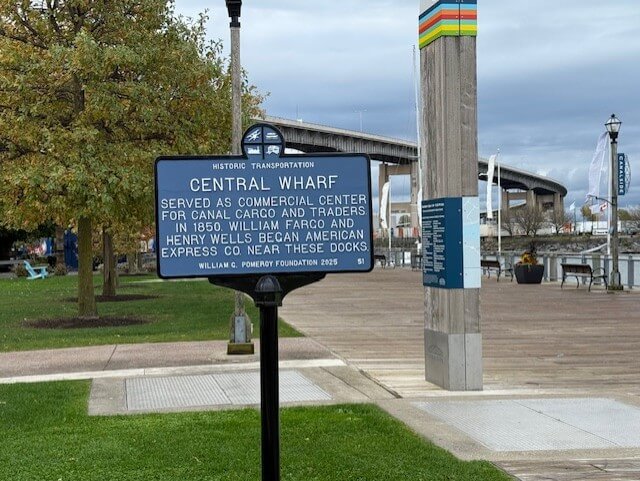
CENTRAL WHARF
- Program
- Subject
- Location
- Lat/Long
- Grant Recipient
-
Historic Transportation
-
Site, Transportation
- 44 Prime St, Buffalo, NY 14202, USA
- 42.876484, -78.87929
-
City of Buffalo
CENTRAL WHARF
Inscription
CENTRAL WHARFSERVED AS COMMERCIAL CENTER
FOR CANAL CARGO AND TRADERS.
IN 1850, WILLIAM FARGO AND
HENRY WELLS BEGAN AMERICAN
EXPRESS CO. NEAR THESE DOCKS.
WILLIAM G. POMEROY FOUNDATION 2025
In 1822, the village of Buffalo secured its position as the ending point of the Erie Canal, the 363-mile waterway then under construction. With the canal’s opening in 1825, Buffalo grew into a major city and transportation hub.
A commercial center for canal cargo and traders known as the Central Wharf developed along Buffalo’s harbor. This was where vessels arriving from the Great Lakes and the Erie Canal could unload and sell their cargo. It became a busy area with commission merchants and traders located along the Central Wharf, in addition to many commercial buildings being constructed throughout the surrounding area.
Serving as a major economic and business hub, the Central Wharf fueled the rise of many business ventures in the city, most notably the American Express Company which formed to extend express lines west of Buffalo. Formed in 1850 by William Fargo and Henry Wells through a merger of their preexisting express companies, American Express had its offices on Main Street immediately adjacent to the busy Central Wharf business area.
The Central Wharf was drastically altered with the laying of railroad tracks through the area by the Delaware, Lackawanna & Western Railroad in the 1880s, with many buildings being torn down. As of 2025, a boardwalk has been reconstructed in the original location of the Central Wharf to mimic the historical layout of the area. Currently, it is a community space and a public walkway along the water.