DAVID J. MARR
- Program
- Subject
- Location
- Lat/Long
- Grant Recipient
-
NYS Historic
-
Building, People, Site
- 22 N Maple St, Warsaw, NY 14569, USA
- 42.741265423227, -78.139205980201
-
Warsaw Historical Society and The Gates House Museum
DAVID J. MARR
Inscription
DAVID J. MARR1882-1951. CO-FOUNDED
CA. 1915 MARR & COLTON CO.
KNOWN FOR CRAFTING CUSTOM
CONCERT ORGANS FOR THEATERS
AND CHURCHES. LIVED HERE.
WILLIAM G. POMEROY FOUNDATION 2026
David J. Marr was born in London, England, in 1882, where he completed a seven-year apprenticeship in pipe organ building. He immigrated to the United States in 1904 and initially worked for the Skinner Organ Company in Boston. In 1907, he joined Robert Hope-Jones at the newly established Hope-Jones Electric Organ Company in Elmira, New York. Hope-Jones, recognized for developing pneumatic and electrical innovations in theatrical organs, was a former colleague of Marr’s from both England and Skinner. During this period, Marr met his future business partner, John Colton.
Following the sale of the Hope-Jones firm to the Wurlitzer Company in Tonawanda around 1913, both Marr and Colton worked for Wurlitzer for approximately two and a half years. In 1914, they began the process of establishing their own company. After being recruited by investors from Warsaw, New York, they constructed a factory on Industrial Street. The facility opened in 1915, and its first organ was installed at the Oatka Theater in Warsaw.
At its peak, the company employed 375 people and maintained branch offices in New York City, Detroit, and Hollywood. The firm produced an estimated 500 to 600 organs for theaters, churches, residences, and radio stations. These theater organs were designed to accompany silent films and featured complex mechanisms capable of producing percussive sounds, chimes, and xylophone effects. The company’s largest installation occurred in 1927 at the Rochester Theater, featuring a five-manual, 24-rank instrument.
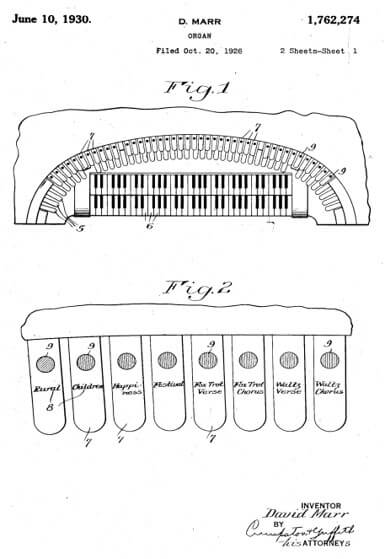
In 1930, Marr received a patent for the Symphonic Registrator, a mechanism that allowed organists to select specific tone colors and moods, such as “suspense”, “happiness”, or “rural” via a single button. However, the company ceased operations in 1932 due to the Great Depression and the declining demand for theater organs following the advent of sound in motion pictures. Marr performed organ repair work until his death in 1951. He resided in his Warsaw home with his wife, Nancy, from 1925 until his passing.