DR. ROBERT HINGSON
- Program
- Subject
- Location
- Lat/Long
- Grant Recipient
-
Hometown Heritage®
-
Industry & Commerce, People
- 230 Choccolocco St, Oxford, AL 36203, USA
- 33.615089, -85.831849
-
City of Oxford
DR. ROBERT HINGSON
Inscription
DR. ROBERT HINGSON1913-1996. OXFORD NATIVE.
EST. BROTHER’S BROTHER
FOUNDATION IN 1958. USED
“PEACE GUN” TO HELP
ELIMINATE SMALLPOX.
WILLIAM G. POMEROY FOUNDATION 2026
Dr. Robert Hingson was born in Oxford, Alabama on April 13, 1913. He grew up here on Chocoloco Street, although his home has since been demolished. In 1931, Hingson was valedictorian of his high school class. He then attended the University of Alabama, and Emory University’s medical school graduating in 1938. He then began an internship at the U.S. Marine Hospital on Staten Island in NY. Hingson joined the U.S. Coast Guard as a medical officer aboard several ships. He also worked for the Mayo Clinic from 1939 to 1941. During this time, he began developing a new technique for the delivery of caudal anesthetics during childbirth, or what we also call “the epidural”. Although the concept of injecting anesthetic medication into the spine was not new, Hingson and his colleague Waldo B. Edwards, who was the chief of obstetrics for the U.S. Marine Hospital, developed a method of continuous use of anesthetic by using an indwelling needle and a flexible catheter, which was a new and critical innovation. They published their work in 1943, and the technique has been used since. Hingson was only just beginning his contributions to the medical field.
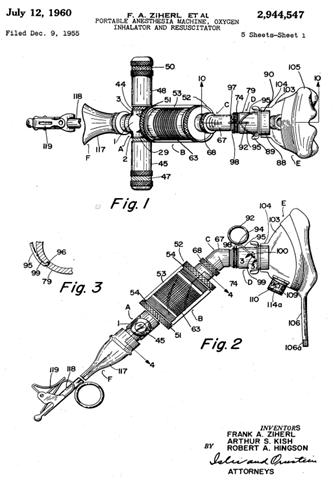
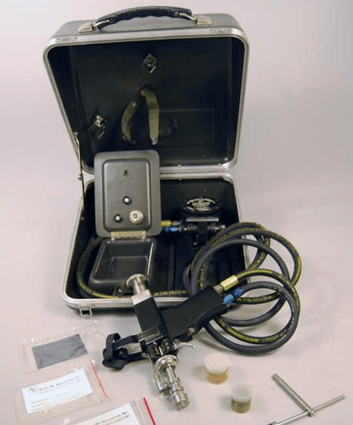
Following WWII, it was reported that Hingson served as the first professor of anesthesiology at the University of Tennessee College of Medicine. In 1948, he went on to work for both Johns Hopkins University School of Medicine and Case Western Reserve School of Medicine. He toured the U.S. and Europe lecturing on anesthesiology and the caudal anesthetic technique he had developed. During this time, he invented a portable anesthesia machine called the Western Reserve Anesthesia Machine, Oxygen Inhalator, and Resuscitator, for which he filed a patent in 1960 along with two other co-inventors. The machine delivered a steady stream of anesthetics for between 3 to 20 minutes, and was for use in dental, obstetrics, and emergency situations.
Hingson also began to take medical missionary trips to impoverished countries. In order to facilitate these trips, he founded the organization called “Brother’s Keeper” in 1958. Only a few years later the name was changed to “Brother’s Brother”, reportedly due to a Nigerian man informing Hingson that they didn’t need a “keeper”, they needed a “brother”.
Hingson also made contributions to the invention of the jet inoculator, a device that could painlessly inject vaccinations without a needle. As early as 1947, Hingson published papers on the use of the jet injection method. Although he credited a pharmaceutical company as responsible for its development, Hingson ran clinical trials to study its use. In 1962 and 1963, two patents were filed for the Multi-dose Jet Injection Devices, and both were under the name of Aaron Ismach. One of the main benefits of the jet inoculator was the fact that it could deliver many precise doses from one cartridge, unlike needles which could only deliver one. It could deliver as many as 1,000 doses in an hour, and was also painless and portable.
Dr. Hingson began using the device in his medical missionary work through Brother’s Brother. In 1962, Hingson and a team of physicians went to Liberia and vaccinated 80% of the population, nearly eliminating smallpox. This caught the attention of the World Health Organization, who adopted the “Peace Gun” in their own operations.
In September 1967, it was reported that Hingson was taking 84 volunteers and the jet injection device to Costa Rica, and planned to inoculate 1.5 million people against smallpox, measles, polio, diphtheria, tetanus, whooping cough, and influenza. By 1967, the jet inoculator had earned the nicknames “Pistol of Peace”, and “Peace Gun”. The next year, it was reported that 6 million people had been immunized globally against measles, tuberculosis, and smallpox by the Foundation’s 200 volunteers.
In 1968, the University of Pittsburgh offered Dr. Hingson roles at the Medical Center, Dental School, and School of Public Health. He also served as Chief of Anesthesiology for the Magee-Women’s Hospital. By this time, he had published two textbooks on anesthesiology, as well as served as the President of the Anesthesia Educational and Relief Foundation of the World Federation of Societies of Anesthesiologists for four years.
In 1976, it was reported that the Brother’s Brother Foundation had served 58 countries and provided 500 million immunizations. Dr. Hingson reported that smallpox had been eliminated in the United States and Canada by 1965, and then the Western Hemisphere by 1966. Over the ten years between 1966 and 1976, Dr. Hingson’s foundation and the WHO focused on the African and Asian continents and claimed to have successfully eliminated the illness by January of 1976.
In this article, Dr. Hingson credited the success in eliminating smallpox to religiously oriented medical missionaries and the “Peace Gun” invention. He also said that the next targets for the Foundation would be measles and influenza. Hingson also claimed to be experimenting with its use for birth control and insulin injections (The Hamilton Spectator, July 24, 1976).
By 1995, The Brother’s Brother Foundation reached a milestone of $500 million donated in the form of medical and agricultural supplies. Dr. Hingson had retired a few years before, and the $70 million per year operation was taken over by his son, Luke Hingson. Dr. Robert Hingson passed away in Pittsburgh in October of 1996.