DR. WASHINGTON
- Program
- Subject
- Location
- Lat/Long
- Grant Recipient
-
Hometown Heritage®
-
Building, Event, People
- 107 N Market St, Washington, NC 27889, USA
- 35.542193, -77.054862
-
City of Washington
DR. WASHINGTON
Inscription
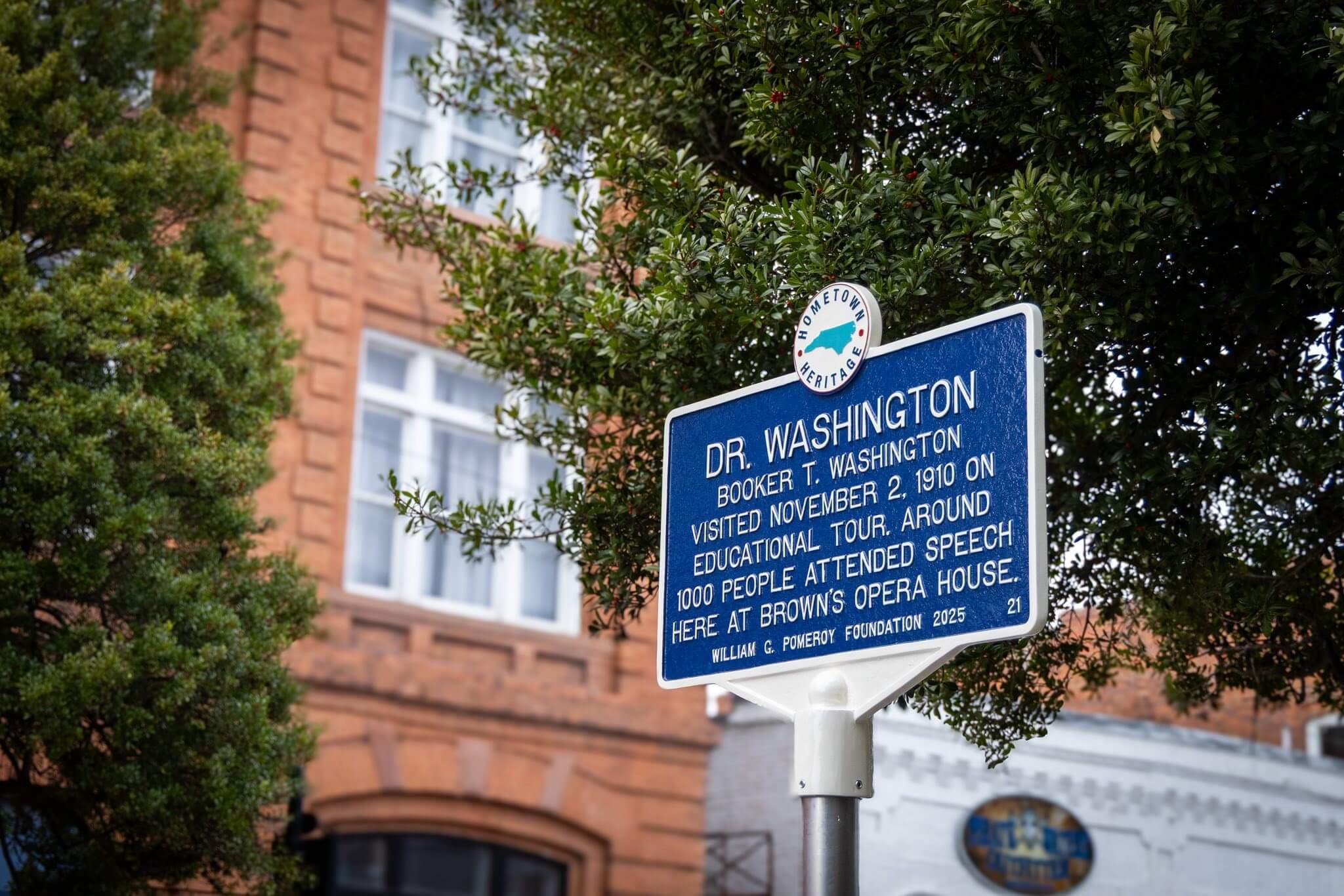
DR. WASHINGTONBOOKER T. WASHINGTON
VISITED NOVEMBER 2, 1910 ON
EDUCATIONAL TOUR. AROUND
1000 PEOPLE ATTENDED SPEECH
HERE AT BROWN’S OPERA HOUSE.
WILLIAM G. POMEROY FOUNDATION 2025
On November 2nd, 1910 Dr. Booker T. Washington visited Washington, NC on his educational tour of the south. Dr. Washington’s visit and speech was highly anticipated, as the newspapers announced it in advance and encouraged people to reserve seats ahead of time for 50 cents (“At Brown’s Opera House”, Washington Daily Times, November 1st, 1910, p. 1).
On the day of the speech, the Washington Daily Times announced that Dr. Washington, the President of the Tuskegee Normal and Industrial Institute, would be arriving on the Atlantic Coast Line along with at least 25 other notable people in his party. Dr. Washington was to be hosted at the home of Prof. W. G. Saunders, on Fourth Street, and his speech was to be given at 8:30pm at Brown’s Opera House, formerly in this building at 103 N. Market Street. Following the speech was a banquet, open to the public, in the colored Masonic Hall on Fifth Street. The article notes that there will be seats reserved for white people “separate and apart from those for the colored” (November 2, 1910).
The following day, the Washington Daily Times published a lengthy article on Dr. Washington’s speech and the event. They estimated that “about one thousand people, one third of whom were white” had attended. They describe Dr. Washington’s speech as “strong, vigorous, and forcible”. The article describes the tour and highlights the successful speech Dr. Washington had recently given at Rocky Mount to a crowd of 4,000 people. They also detailed his brief stops in smaller towns along the railroad line, where he addressed the issues affecting the rural southern African American population.
The article quotes Reverand Nathaniel Harding who introduced Dr. Washington, saying, “Dr. Washington comes to us, not as a politician, not as a demagogue, seeking self aggrandizement, but as the recognized leader of his race. He has sought to lead his people in the paths of moral and intellectual uplift and development…”. According to the article, Dr. Washington spoke for an hour and a half on the topics of progress, justice, morality, and education. The article quotes him saying, “The negro wants education for his children. He has an ambition to improve the condition of his family.” Dr. Washington also discussed the ways in which African Americans were drawn to the cities and away from rural life due to greater safety and better education opportunities but faced a moral crisis in the temptations of gambling, drinking, etc. more widely available in the cities. He called upon white neighbors to help and support communities as they strove to improve and emphasized that both races benefitted from working together. He placed an emphasis on teaching a love of labor and working, and of appreciating the “useful” country way of living. The article quoted Dr. Washington extensively, including transcriptions of much of his speech, celebrating his visit and his wisdom (November 3rd, 1910).