ENDURANCE RUN
- Program
- Subject
- Location
- Lat/Long
- Grant Recipient
-
NYS Historic
-
Event
- 358 NY-17C, Waverly, NY 14892, USA
- 42.009415, -76.50391
-
Waverly Historical Society
ENDURANCE RUN
Inscription
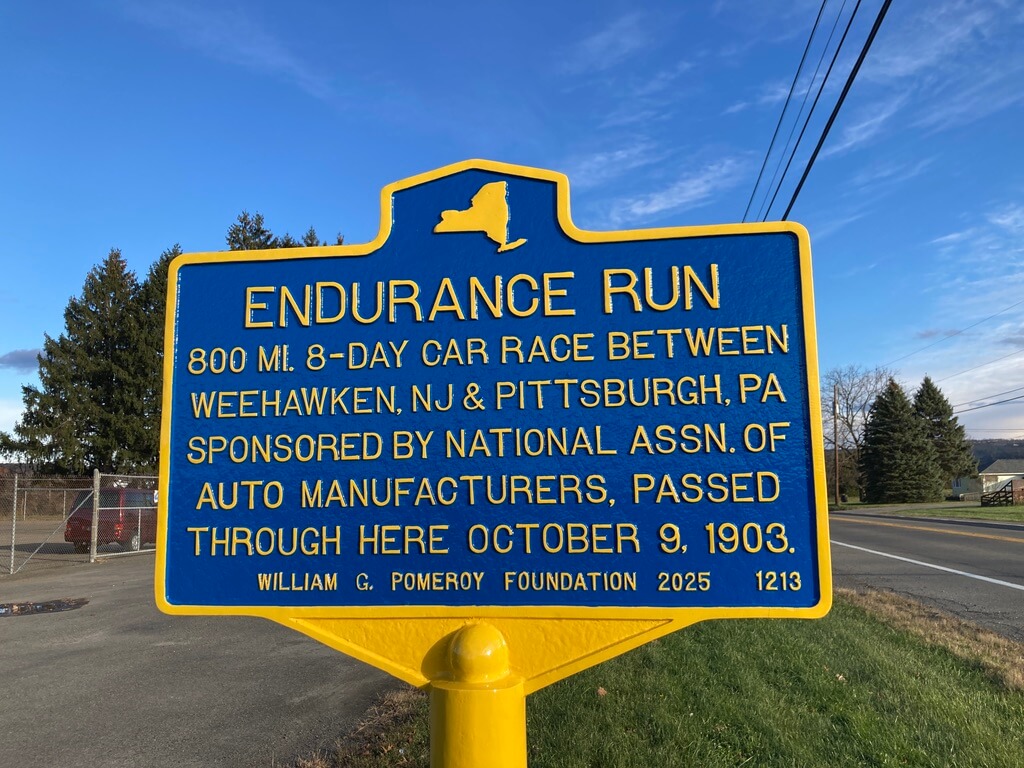
ENDURANCE RUN800 MI. 8-DAY CAR RACE BETWEEN
WEEHAWKEN, NJ & PITTSBURGH, PA
SPONSORED BY NATIONAL ASSN. OF
AUTO MANUFACTURERS, PASSED
THROUGH HERE OCTOBER 9, 1903.
WILLIAM G. POMEROY FOUNDATION 2025
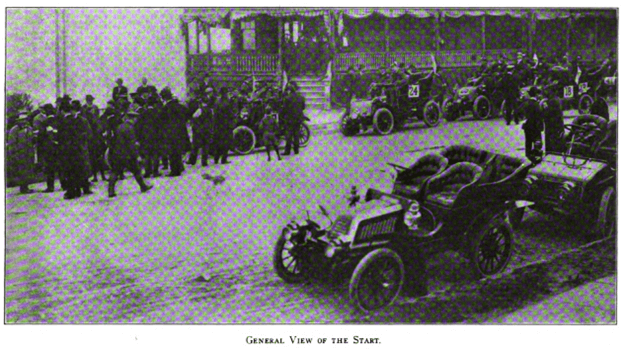
The National Association of Auto Manufacturers was formed in 1900 by a small number of early car manufacturers and inventors. In 1903, the association sponsored an endurance run consisting of an 800-mile race beginning at Weehawken, New Jersey and finishing in Pittsburgh, Pennsylvania. The race started on October 7, 1903, with 34 automobiles leaving Weehawken in batches at half minute intervals. It was led by two pilot cars that marked the roads as they went, and observers were assigned to ride in each car.
The early automobile trade magazine, The Horseless Age, had reporter Harry B. Haines follow contestants by train, providing coverage of the race over several issues of the publication. Coverage was also provided throughout the race by several passengers riding in the competing cars. The October 14, 1903 issue of The Horseless Age noted that drivers carried extra tires, sparkplugs, and various extra parts such as nuts and bolts, chain links, and valves, and that “Several of the cars were being operated by the manufacturers and inventors, a circumstance indicative of the interest taken by them in the contest.” It continued, writing:
It was a great comparison to note the vast difference in the proportion of the entries. A towering 2,500 pound touring car, carrying seven passengers, and listed to cost $7,000, stood beside and overshadowed a tiny runabout, weighing 880 pounds, carrying two passengers and costing $650, and yet both machines were to go over the same roads under practically the same relative conditions, and both would, it was expected, cover the ground without mishap.
After Traveling north from Weehawken, the first day’s route ended in Pine Hill in Ulster County, New York. The second day’s route continued west through New York state, going as far north as Unadilla in Otsego County, before ending in Binghamton. The endurance run contestants saw very poor road conditions, with heavy rains causing slippery roads, deep mud, and cars becoming drenched. Some drivers had taken precautions using leather or canvas covers for protection from the mud and dust.
Setting off from Binghamton on the third day of the race, drivers continued west eventually passing through the village of Waverly in Tioga County. The local paper, The Waverly Free Press reported on the spectacle, writing of the poor road conditions with mud “eight inches deep for long stretches at a time.” After ending the third day in Bath in Steuben County, the contestants continued northwest to Buffalo on the fourth day, traveled southwest to Erie, Pennsylvania on the fifth day, to Cleveland, Ohio on the sixth day, and then Youngstown, Ohio on the seventh day. On October 14, the eighth and final day of the race, the cars finally reached Pittsburgh.
The National Association of Auto Manufacturers noted that, “The examiner found that the cars arrived at Pittsburg in better condition than had been thought possible even by the most optimistic” (The Horseless Age, November 11, 1903, 507). At the December 1903 meeting of the association, gold medals were awarded for meritorious performance to eight of the contestants (The Horseless Age, December 9, 1903, 608).