GOLDEN SPIKE
- Program
- Subject
- Location
- Lat/Long
- Grant Recipient
-
Historic Transportation
-
Site, Transportation
- 415 N Monroe St, Spokane, WA 99201, USA
- 47.66126, -117.427198
-
Jonas Babcock Chapter, Daughters of the American Revolution
GOLDEN SPIKE
Inscription
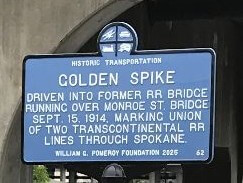
GOLDEN SPIKEDRIVEN INTO FORMER RR BRIDGE
RUNNING OVER MONROE ST. BRIDGE
SEPT. 15, 1914, MARKING UNION
OF TWO TRANSCONTINENTAL RR
LINES THROUGH SPOKANE.
WILLIAM G. POMEROY FOUNDATION 2025
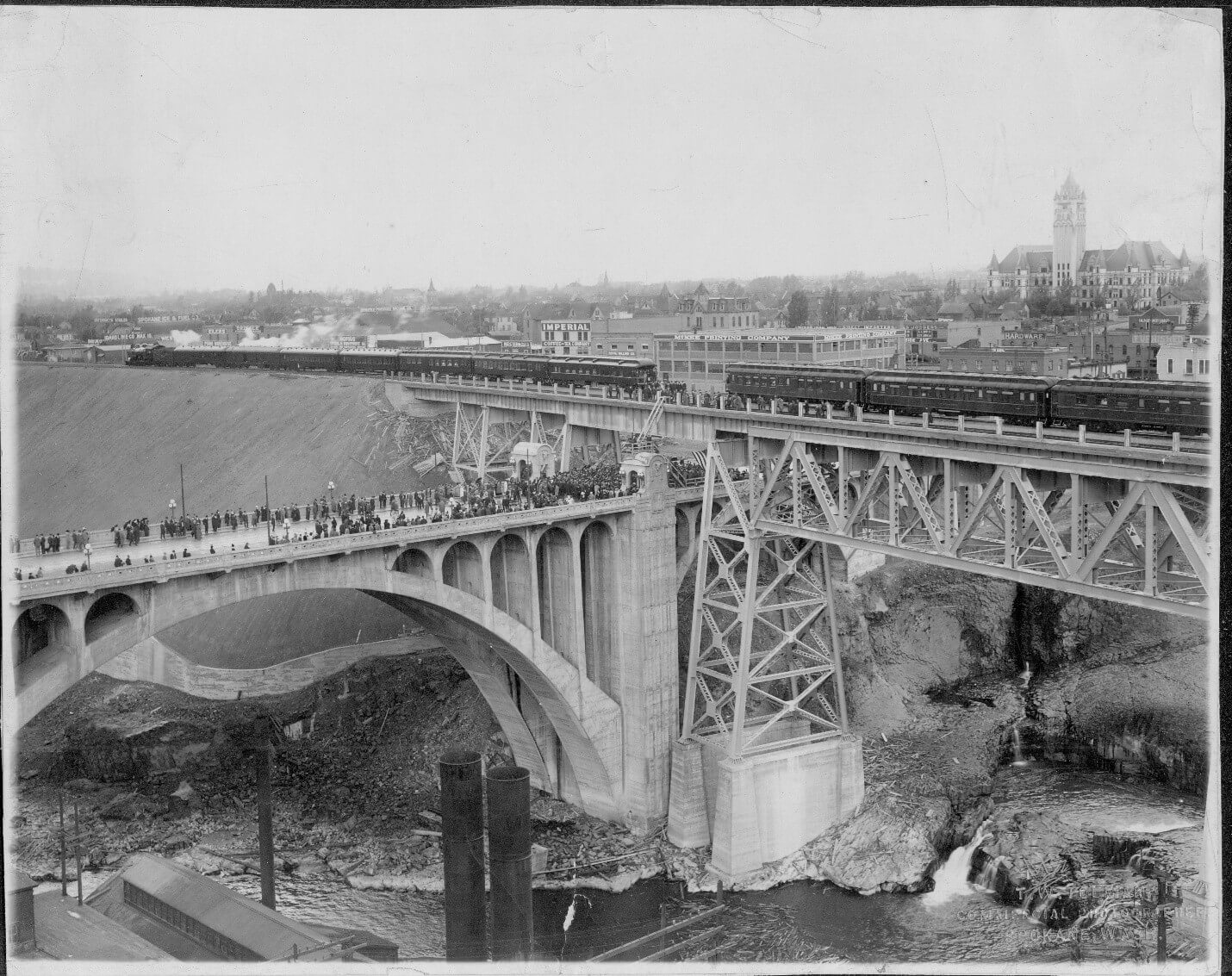
On September 15, 1914, a large crowd watched as railroad officials ceremoniously drove a golden spike into a railroad bridge running through the city of Spokane, Washington, marking the completion of an enormous railway project that saw the unification of two transcontinental lines through the city. The September 16, 1914 Spokesman-Review claimed that the project cost $16,500,000 and was carried out by the Oregon-Washington Railroad & Navigation Company, a subsidiary of Union Pacific, and the Chicago, Milwaukee & St. Paul Railway. After the completion of the project, Spokane grew as a railroad hub now being part of the Union Pacific Railroad system, with its line running from the west and the Chicago, Milwaukee & St. Paul Railway line, known as the Milwaukee Road, running from the east.
In addition to a series of elevated tracks that allowed trains to travel through Spokane over Spokane River and the city streets, the project included the completion of Union Station located in the center of downtown Spokane. The golden spike ceremony was attended by railroad officials, businessmen, members of the city and county government, and citizens of Spokane. Temporary stairs were constructed from the Monroe Street bridge running below the railroad structure to allow for officials and witnesses to climb up and see the driving of the spike.
After years of dwindling traffic on the line, in the 1970s the elevated railroad tracks running through Spokane were removed and in 1973, Union Station was demolished (Devrick Barnett, “Union Pacific Rail Depot,” Spokane Historical, spokanehistorical.org/items/ show/835) marking an end to this era of transportation history in the city.