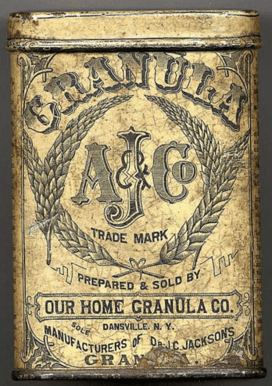
GRANULA
- Program
- Subject
- Location
- Lat/Long
- Grant Recipient
-
Hungry for History®
-
Food, People
- 186 Main St, Dansville, NY 14437, USA
- 42.56169, -77.69648
-
Dansville Area Historical Society
GRANULA
Inscription
GRANULAEARLY BREAKFAST CEREAL
INVENTED CA. 1876 IN DANSVILLE
BY DR. J. C. JACKSON. GRAHAM
WHEAT FLOUR & WATER MIXED,
BAKED, THEN BROKEN UP.
WILLIAM G. POMEROY FOUNDATION 2026
As of 2026, many people eat granola as a breakfast or snack. The origins of the cereal go back to the 1800s when Dr. James C. Jackson developed the food as a hygienic (meaning healthy) food for his sanitarium, or what we would now call a spa. It is similar to hardtack, which predates it (used as far back as the Roman Empire), but is composed of different ingredients, and is eaten in a different manner.
Granula goes back to its inventor- Dr. James Caleb Jackson, who was born in Manlius, NY in 1811. His father was an allopathic physician, and James was born very sickly. His father treated him with many early medicines we now recognize as poisons, like strychnine. Nevertheless, James survived and went on to study at Central Medical College in 1850. He became a staunch abolitionist, working as an editor and author for the National Anit-Slavery Standard and the Albany Patriot. He was a known friend of Frederick Douglass.
After experiencing healing effects from a “water cure” treatment at a sanitarium in Cuba, NY, he studied to become a hydropathy practitioner and purchased a sanitorium in Dansville, NY in 1858 which he named “Our Home on the Hillside”. Dr. Jackson advocated simple foods, clean air & water, sunshine, sleep, exercise, and hydrotherapy as needed. He believed in the power of the body to heal itself when a healthy lifestyle was maintained, which was not yet part of mainstream medicine. His emphasis on hygiene influenced other doctors, such as Dr. Harriett Newell Austin and Clara Barton.
As part of his simple diet protocol, he developed Granula. Believing that the digestive system was the source of most illnesses, he sought to develop a simple food that was easily digestible. The result was graham flour mixed with water, which was then rolled out and baked, and then crushed or ground. Granula was so hard that it required soaking in water, or more often milk, before eating. It was promoted as a healthy and easy cold Sunday breakfast. Dr. Jackson is thought to have developed Granula as early as 1863 but did not patent the trademark until 1876.
Dr. Jackson’s health magazine and sanitarium were already very popular by this time, and so a high demand for Granula warranted the establishment of a factory nearby in Dansville. The factory first sat on the corners of Spruce and Milton Streets, but by 1898 it had moved to a building on Main Street. It was produced by Our Home Granula Company until at least 1920.
So, how did granula become granola? Around 1881, Dr. John Kellogg began producing his own granula at his Michigan sanitarium, even calling it by the same name. However, Dr. Jackson had already trademarked the name and sued him. Kellogg changed the name of his product to Granola to avoid losing the battle. C. W. Post, a patient of Dr. Kellogg’s, went on to make Grape Nuts in 1908, which was yet another variant of granula, showing how influential granula was on the early cereals and breakfast foods in America.