NEVERSINK AQUEDUCT
- Program
- Subject
- Location
- Lat/Long
- Grant Recipient
-
Historic Transportation Canals
-
Transportation
- 37 Hoag Rd, Cuddebackville, NY 12729, USA
- 41.458784, -74.603473
-
Town of Deerpark
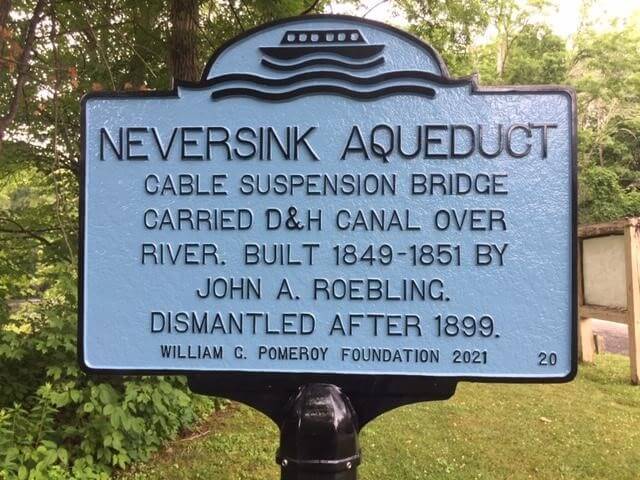
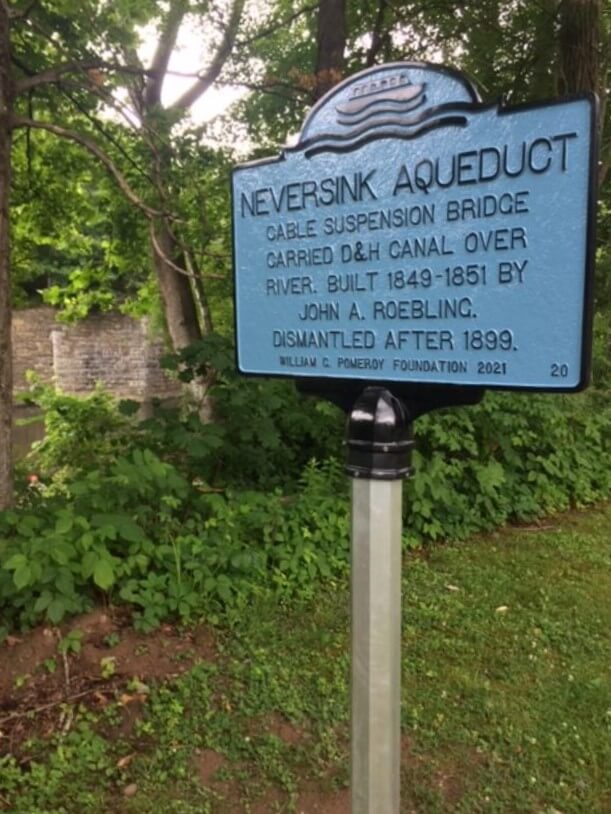
NEVERSINK AQUEDUCT
Inscription
NEVERSINK AQUEDUCTCABLE SUSPENSION BRIDGE
CARRIED D&H CANAL OVER
RIVER. BUILT 1849-1851 BY
JOHN A. ROEBLING.
DISMANTLED AFTER 1899.
WILLIAM G. POMEROY FOUNDATION 2021
Opened in 1828, the Delaware and Hudson Canal (D&H Canal) spanned 108 miles and featured locks, aqueducts, and bridges to transport coal from mines in Pennsylvania to markets along the Hudson River and in New York City. John A. Roebling, a Prussian civil engineer, designed the Neversink Aqueduct, which was constructed under his supervision from 1849 to 1851. In a letter to the American Railroad Journal in 1849, Roebling described the proposed scale for the Neversink Aqueduct:
I have contracted with the company, for two more aquaducts [sic], one over the Roundout [sic] river, the other over the Sink [sic] river, of 170 feet span, requiring cables of 9 ½ inches diameter, large enough for the support of a suspension bridge over the Niagara river, at the site in contemplation below the falls, of 750 feet span.
Sources credit Roebling with the development of wire cables, which he used in his designs for the Neversink Aqueduct as well as three other cable suspension aqueducts on the D&H Canal. Roebling later became renowned for his design of the Brooklyn Bridge. By 1899, the D&H Canal was abandoned and the Neversink Aqueduct was dismantled.