SEAWALL SOCIETY
- Program
- Subject
- Location
- Lat/Long
- Grant Recipient
-
NYS Historic, Pomeroy Education Program
-
Arts & Culture, Site
- 79 Fuhrmann Boulevard, Buffalo, NY 14203, USA
- 42.87325, -78.881694
-
City of Buffalo
SEAWALL SOCIETY
Inscription
SEAWALL SOCIETYAN ESTABLISHED IRISH IMMIGRANT
COMMUNITY ON BUFFALO’S
OUTER HARBOR WAS DISPLACED
BY INDUSTRIAL DEVELOPMENT
BETWEEN CA. 1883-1914.
DEPEW HIGH SCHOOL
WILLIAM G. POMEROY FOUNDATION 2026
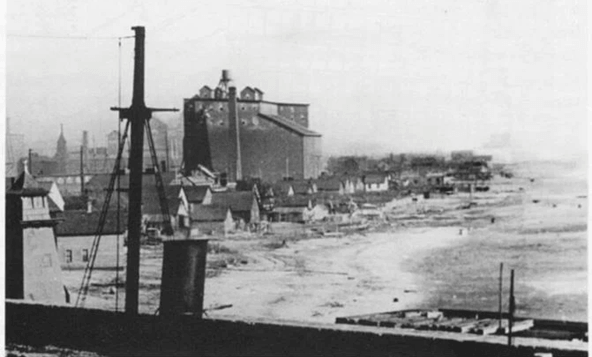
During the mid-19th century, Irish immigrants settled in Buffalo, New York, in increasing numbers. By 1880, the US Census and city directories recorded hundreds of residents living “on the Island” or along the “sea wall” on Buffalo’s Outer Harbor. This land, first acquired by the City of Buffalo in 1863, featured a wall constructed to prevent Lake Erie from eroding the shoreline. Residents built homes in this vicinity, sometimes utilizing the concrete wall as a foundation for their structures.
Industrial expansion began to threaten the community as early as 1883. That year, the Workingmen’s city convention passed a resolution accusing city officials of corruption for attempting to sell the land to the Buffalo Creek Railroad. While the convention acknowledged the residents were technically squatting, they supported the mayor’s veto of the sale and opposed the eviction of the inhabitants. Despite this executive opposition, city officials pursued legal action to remove the community, resulting in decades of litigation. Many residents lost their appeals because they lacked formal legal standing, despite having occupied the land for multiple generations.
By 1910, the Sea Wall settlement occupied a strip of land 1.25 miles long and 130 feet wide. During this period, the city negotiated with the Erie and Lehigh Valley Railroads and planned turnpike expansions to increase industrial traffic while maintaining shoreline water rights. By 1914, after 30 years of legal disputes, the city began offering financial compensation to the few remaining residents in exchange for the relinquishment of their claims. In August 1914, the remaining inhabitants reached an agreement with Mayor Fuhrmann to vacate the land for a total compensation of $13,000, despite some officials arguing that the residents held no valid titles to the property.
Following the evictions, the area was developed for industrial use, and the original homes and businesses were demolished. Over time, the land use shifted again. As of 2026, the site has been largely transformed into a city park and nature preserve, though some industrial operations continue nearby.
The student-led application for this grant came from students at Depew High School, led by instructor Maria Hoch. The students researched the Seawall Society, and the City of Buffalo submitted the required materials for the historical marker on their behalf as part of our Pomeroy Education Program.