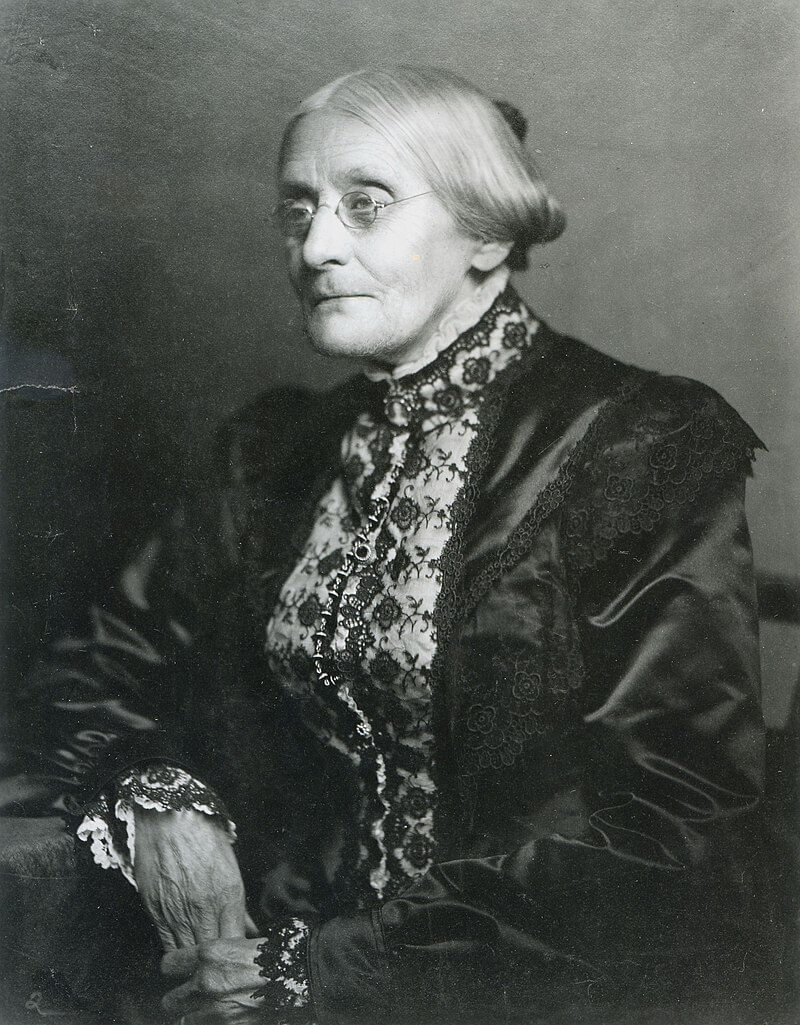
SUSAN B. ANTHONY
- Program
- Subject
- Location
- Lat/Long
- Grant Recipient
-
National Votes for Women Trail
-
Event
- 27 N Main St, Canandaigua, NY 14424, USA
- 42.888606, -77.281633
-
National Collaborative for Women's History Sites
SUSAN B. ANTHONY
Inscription
SUSAN B. ANTHONYTRIED HERE IN FEDERAL COURT
ON JUNE 17-18, 1873 FOR
ILLEGAL VOTING. JUDGE
DIRECTED JURY TO GIVE GUILTY
VERDICT AND ISSUED $100 FINE.
WILLIAM G. POMEROY FOUNDATION 2021
On June 17 and 18, 1873, leading suffragist Susan B. Anthony was tried in United States circuit court, held in the Ontario County Court House in Canandaigua, New York. Anthony had voted in the previous year’s election for a representative in the United States Congress. The constitution and laws of New York State authorized that only male citizens could vote. Therefore, her voting was deemed an illegal act, and she was subsequently arrested and charged for knowingly voting without having the lawful right to vote. Anthony on the other hand contended that as a citizen, the Fourteenth Amendment of the United States Constitution guaranteed her right to vote, and that by restricting suffrage to only male citizens, the state constitution was in violation of the Fourteenth Amendment. Having been recently ratified in 1868, the Fourteenth Amendment was intended to confer citizenship and equal legal and civil rights for newly freed African Americans after the American Civil War. It reads in part that, “No State shall make or enforce any law which shall abridge the privileges or immunities of citizens of the United States.” Anthony argued that as a citizen, she had the right to vote, and that the state constitution was in violation of her right.
Judge Ward Hunt, United States Supreme Court Associate Justice and circuit rider, presided over Anthony’s trial. The June 18, 1873 edition of the Rochester Democrat and Chronicle reported that the court room was “thronged with interested spectators,” including fellow suffragist Matilda Joslyn Gage and former president Millard Fillmore. Anthony was not allowed to testify at her trial. Judge Hunt directed the jury to give a guilty verdict and issued her a $100 fine, which she refused to pay.
Anthony’s 1873 trial and the 1875 United States Supreme Court case Minor v. Happersett, in which the Supreme Court declared that citizenship did not automatically guarantee the right to vote, led to a national shift in the women’s suffrage movement. Suffragists then focused their efforts on individual state constitutional amendments and ultimately a federal constitutional amendment that would secure women’s right to vote across the country.
After decades of activism, in 1917 suffragists saw victory in New York, when a state constitutional amendment secured New York women’s right to vote. Victory in New York helped to influence public support for women’s suffrage on a national scale, and on June 4, 1919, the United States Congress passed the Nineteenth Amendment which reads, “The right of citizens of the United States to vote shall not be denied or abridged by the United States or by any state on account of sex.” By August 1920, the necessary 36 states had ratified the amendment, securing women’s right to vote across the United States.