VOTES FOR WOMEN
- Program
- Subject
- Location
- Lat/Long
- Grant Recipient
-
National Votes for Women Trail
-
Event
- 815 W 4th St, Williamsport, PA 17701, USA
- 41.239618, -77.018219
-
National Collaborative for Women's History Sites
VOTES FOR WOMEN
Inscription
VOTES FOR WOMENJUSTICE BELL, REPLICA OF
LIBERTY BELL, TOURED PA TO
RAISE AWARENESS & SUPPORT
FOR WOMEN’S SUFFRAGE. PARADE
PASSED HERE AUGUST 11, 1915.
WILLIAM G. POMEROY FOUNDATION 2021
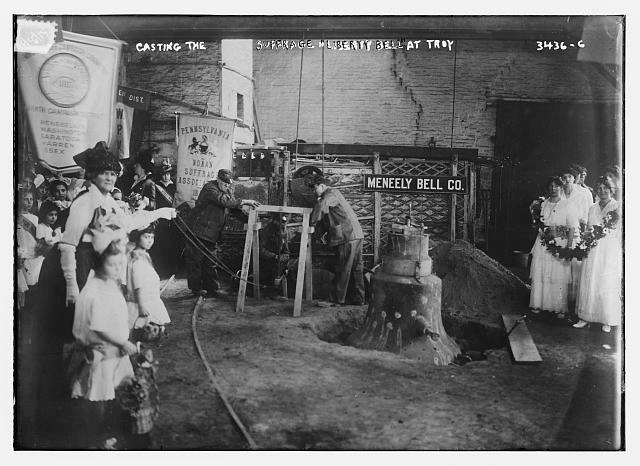
In 1915, suffragist Katharine Wentworth Ruschenberger (1853-1943) of Strafford, Pennsylvania funded and oversaw the casting of a bronze replica of the Liberty Bell to be used in the Pennsylvania Woman Suffrage Association’s suffrage campaign. It was cast by Meneely Bell Foundry in Troy, New York and Ruschenberger had “establish justice” added above the motto on the bell. It became known as the Justice Bell. It was cast without a crack and its clappers were chained so that the bell could not ring until women had secured the right to vote.
Pennsylvania suffragists had been lobbying for the passage of a women’s suffrage amendment to the state constitution that would secure women’s right to vote in the state. In 1913, the state legislature passed a women’s suffrage amendment and in 1915 it went before voters of the state for ratification. Suffragists used the Justice Bell on a tour the state in order to raise awareness and support among voters for the women’s suffrage amendment. During this tour, the Justice Bell passed through Williamsport, Pennsylvania on August 11, 1915.
The Pennsylvania state report included in volume six of the History of Woman Suffrage recounted the Justice Bell publicity tour:
Mrs. Ruschenberger’s Bell was the best and main publicity feature and undeniably secured many thousands of votes. It visited all the counties, traveling 3,935 miles on a special truck. Hundreds of appeals by as many speakers were made from this as a stand and it was received in the rural communities with almost as much reverence and ceremony as would have been accorded the original bell. The collections and the receipts from the sale of novelties moulded [sic] in the likeness of the bell helped materially to defray the heavy expense of operating the truck, paying the speakers’ expenses and providing literature.
Despite the efforts of Pennsylvania suffragists and the Justice Bell publicity tour, voters of the state rejected the women’s suffrage amendment. After this, Pennsylvania suffragists shifted strategy to work toward the passage of a federal suffrage amendment.
Finally, on June 4, 1919, the United States Congress passed the Nineteenth Amendment which states, “The right of citizens of the United States to vote shall not be denied or abridged by the United States or by any state on account of sex.” On June 24, Pennsylvania ratified the federal amendment. By August 1920, the necessary 36 states had ratified the Nineteenth Amendment, securing women’s right to vote across the United States. After ratification of the Nineteenth Amendment, the Justice Bell was unchained and rung at a celebration held at Independence Square in Philadelphia.